

The Global System for Mobile Communications, GSM (original acronym: Groupe Spécial Mobile) is the most popular standard for mobile phones in the world. GSM service is used by over 2 billion people across more than 212 countries and territories. The ubiquity of the GSM standard makes international roaming very common between mobile phone operators, enabling subscribers to use their phones in many parts of the world. GSM differs significantly from its predecessors in that both signaling and speech channels are Digital call quality, which means that it is considered a second generation (2G) mobile phone system. This fact has also meant that data communication was built into the system from the 3rd Generation Partnership Project (3GPP).
From the point of view of the consumers, the key advantage of GSM systems has been higher digital voice quality and low cost alternatives to making calls such as text messaging. The advantage for network operators has been the ability to deploy equipment from different vendors because the open standard allows easy inter-operability. Like other cellular standards GSM allows network operators to offer roaming services which mean subscribers can use their phones all over the world.
As the GSM standard continued to develop, it retained backward compatibility with the original GSM phones; for example, packet data capabilities were added in the Release '97 version of the standard, by means of GPRS. Higher speed data transmission has also been introduced with EDGE in the Release '99 version of the standard.
Radio interface
Radio interface
GSM is a cellular network, which means that mobile phones connect to it by searching for cells in the immediate vicinity. GSM networks operate in four different frequency ranges. Most GSM networks operate in the 900 MHz or 1800 MHz bands. Some countries in the Americas (including the United States and Canada) use the 850 MHz and 1900 MHz bands because the 900 and 1800 MHz frequency bands were already allocated.
The rarer 400 and 450 MHz frequency bands are assigned in some countries, notably Scandinavia, where these frequencies were previously used for first-generation systems.
In the 900 MHz band the uplink frequency band is 890-915 MHz, and the downlink frequency band is 935-960 MHz. This 25 MHz bandwidth is subdivided into 124 carrier frequency channels, each spaced 200 kHz apart. Time division multiplexing is used to allow eight full-rate or sixteen half-rate speech channels per radio frequency channel. There are eight radio timeslots (giving eight burst periods) grouped into what is called a TDMA frame. Half rate channels use alternate frames in the same timeslot. The channel data rate is 270.833 kbit/s, and the frame duration is 4.615 ms.
The transmission power in the handset is limited to a maximum of 2 watts in GSM850/900 and 1 watt in GSM1800/1900.
GSM has used a variety of voice codecs to squeeze 3.1kHz audio into between 6 and 13kbps. Originally, two codecs, named after the types of data channel they were allocated, were used, called "Full Rate" (13kbps) and "Half Rate" (6kbps). These used a system based upon linear predictive coding (LPC). In addition to being efficient with bitrates, these codecs also made it easier to identify more important parts of the audio, allowing the air interface layer to prioritize and better protect these parts of the signal.
GSM was further enhanced in the mid-nineties with the GSM-EFR codec, a 12.2kbps codec that uses a full rate channel. Finally, with the development of UMTS, EFR was refactored into a variable-rate codec called AMR-Narrowband, which is high quality and robust against interference when used on full rate channels, and less robust but still relatively high quality when used in good radio conditions on half-rate channels.
There are four different cell sizes in a GSM network - macro, micro, pico and umbrella cells. The coverage area of each cell varies according to the implementation environment. Macro cells can be regarded as cells where the base station antenna is installed on a mast or a building above average roof top level. Micro cells are cells whose antenna height is under average roof top level; they are typically used in urban areas. Picocells are small cells whose diameter is a few dozen meters; they are mainly used indoors. On the other hand, umbrella cells are used to cover shadowed regions of smaller cells and fill in gaps in coverage between those cells.
Cell radius varies depending on antenna height, antenna gain and propagation conditions from a couple of hundred meters to several tens of kilometers. The longest distance the GSM specification supports in practical use is 35 km or 22 miles. There are also several implementations of the concept of an extended cell, where the cell radius could be double or even more, depending on the antenna system, the type of terrain and the timing advance.
Indoor coverage is also supported by GSM and may be achieved by using an indoor picocell base station, or an indoor repeater with distributed indoor antennas fed through power splitters, to deliver the radio signals from an antenna outdoors to the separate indoor distributed antenna system. These are typically deployed when a lot of call capacity is needed indoors, for example in shopping centers or airports. However, this is not a prerequisite, since indoor coverage is also provided by in-building penetration of the radio signals from nearby cells.
The modulation used in GSM is Gaussian minimum shift keying (GMSK), a kind of continuous-phase frequency shift keying. In GMSK, the signal to be modulated onto the carrier is first smoothed with a Gaussian low-pass filter prior to being fed to a frequency modulator, which greatly reduces the interference to neighboring channels (adjacent channel interference).
A nearby GSM handset is usually the source of the "dit dit dit, dit dit dit, dit dit dit" signal that can be heard from time to time on home stereo systems, televisions, computers, and personal music devices. When these audio devices are in the near field of the GSM handset, the radio signal is strong enough that the solid state amplifiers in the audio chain function as a detector. The clicking noise itself represents the power bursts that carry the TDMA signal. This is a form of RFI, and could be mitigated or eliminated by use of additional shielding and/or bypass capacitors in these audio devices, however, the increased cost of doing so is difficult for a designer to justify.
Network structure
GSM was further enhanced in the mid-nineties with the GSM-EFR codec, a 12.2kbps codec that uses a full rate channel. Finally, with the development of UMTS, EFR was refactored into a variable-rate codec called AMR-Narrowband, which is high quality and robust against interference when used on full rate channels, and less robust but still relatively high quality when used in good radio conditions on half-rate channels.
There are four different cell sizes in a GSM network - macro, micro, pico and umbrella cells. The coverage area of each cell varies according to the implementation environment. Macro cells can be regarded as cells where the base station antenna is installed on a mast or a building above average roof top level. Micro cells are cells whose antenna height is under average roof top level; they are typically used in urban areas. Picocells are small cells whose diameter is a few dozen meters; they are mainly used indoors. On the other hand, umbrella cells are used to cover shadowed regions of smaller cells and fill in gaps in coverage between those cells.
Cell radius varies depending on antenna height, antenna gain and propagation conditions from a couple of hundred meters to several tens of kilometers. The longest distance the GSM specification supports in practical use is 35 km or 22 miles. There are also several implementations of the concept of an extended cell, where the cell radius could be double or even more, depending on the antenna system, the type of terrain and the timing advance.
Indoor coverage is also supported by GSM and may be achieved by using an indoor picocell base station, or an indoor repeater with distributed indoor antennas fed through power splitters, to deliver the radio signals from an antenna outdoors to the separate indoor distributed antenna system. These are typically deployed when a lot of call capacity is needed indoors, for example in shopping centers or airports. However, this is not a prerequisite, since indoor coverage is also provided by in-building penetration of the radio signals from nearby cells.
The modulation used in GSM is Gaussian minimum shift keying (GMSK), a kind of continuous-phase frequency shift keying. In GMSK, the signal to be modulated onto the carrier is first smoothed with a Gaussian low-pass filter prior to being fed to a frequency modulator, which greatly reduces the interference to neighboring channels (adjacent channel interference).
A nearby GSM handset is usually the source of the "dit dit dit, dit dit dit, dit dit dit" signal that can be heard from time to time on home stereo systems, televisions, computers, and personal music devices. When these audio devices are in the near field of the GSM handset, the radio signal is strong enough that the solid state amplifiers in the audio chain function as a detector. The clicking noise itself represents the power bursts that carry the TDMA signal. This is a form of RFI, and could be mitigated or eliminated by use of additional shielding and/or bypass capacitors in these audio devices, however, the increased cost of doing so is difficult for a designer to justify.
Network structure
The network behind the GSM system seen by the customer is large and complicated in order to provide all of the services which are required. It is divided into a number of sections and these are each covered in separate articles.
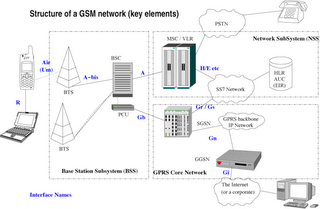
This diagram shows the simplified structure of a GSM network.
It shows that the network is divided into three main sections (although there are others, such as the operations and maintenance network and the intelligent network subsystem).
Subscriber identity module
- the Base Station Subsystem (the base stations and their controllers).
- the Network and Switching Subsystem (the part of the network most similar to a fixed network). This is sometimes also just called the core network.
- the GPRS Core Network (the optional part which allows packet based Internet connections).
- all of the elements in the system combine to produce many GSM services such as voice calls and SMS.
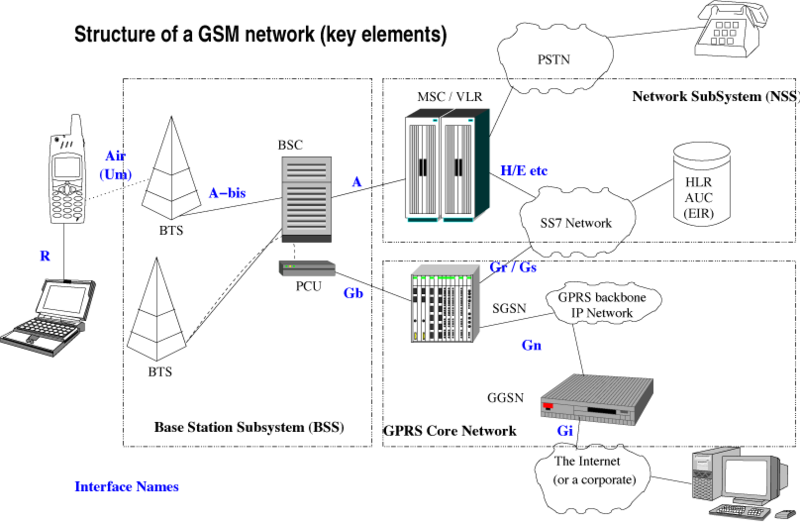
This diagram shows the simplified structure of a GSM network.
It shows that the network is divided into three main sections (although there are others, such as the operations and maintenance network and the intelligent network subsystem).
Subscriber identity module
One of the key features of GSM is the Subscriber Identity Module (SIM), commonly known as a SIM card. The SIM is a detachable smart card containing the user's subscription information and phonebook. This allows the user to retain his or her information after switching handsets. Alternatively, the user can also change operators while retaining the handset simply by changing the SIM. Some operators will block this by allowing the phone to use only a single SIM, or only a SIM issued by them; this practice is known as SIM locking, and is illegal in some countries.
In the United States, Europe and Australia, many operators lock the mobiles they sell. This is done because the price of the mobile phone is typically subsidised with revenue from subscriptions and operators want to try to avoid subsidising competitor's mobiles. A subscriber can usually contact the provider to remove the lock for a fee, utilize private services to remove the lock, or make use of ample software and websites available on the Internet to unlock the handset themselves. While most web sites offer the unlocking for a fee, some do it for free. The locking applies to the handset, identified by its International Mobile Equipment Identity (IMEI) number, not to the account (which is identified by the SIM card). It is always possible to switch to another (non-locked) handset if such other handset is available
Some providers will unlock the phone for free if the customer has held an account for a certain period. Third party unlocking services exist that are often quicker and lower cost than that of the operator. In most countries removing the lock is legal. Cingular provides free unlock services to its customer after 3 months of subscriptions.
In countries like India, Belgium, etc., all phones are sold unlocked. However, in Belgium, it is unlawful for operators there to offer any form of subsidy on the phone's price. This was also the case in Finland until April 1, 2006, when selling subsidized combinations of handsets and accounts became legal though operators have to unlock phone free of charge after a certain amount of time (at most 24 months).
GSM security
GSM was designed with a moderate level of security. The system was designed to authenticate the subscriber using shared-secret cryptography. Communications between the subscriber and the base station can be encrypted. The development of UMTS introduces an optional USIM, that uses a longer authentication key to give greater security, as well as mutually authenticating the network and the user - whereas GSM only authenticated the user to the network (and not vice versa). The security model therefore offers confidentiality and authentication, but limited authorization capabilities, and no non-repudiation.
GSM uses several cryptographic algorithms for security. The A5/1 and A5/2 stream ciphers are used for ensuring over-the-air voice privacy. A5/1 was developed first and is a stronger algorithm used within Europe and the United States; A5/2 is weaker and used in other countries. A large security advantage of GSM over earlier systems is that the Ki, the crypto variable stored on the SIM card that is the key to any GSM ciphering algorithm, is never sent over the air interface. Serious weaknesses have been found in both algorithms, and it is possible to break A5/2 in real-time in a ciphertext-only attack. The system supports multiple algorithms so operators may replace that cipher with a stronger one.
In the United States, Europe and Australia, many operators lock the mobiles they sell. This is done because the price of the mobile phone is typically subsidised with revenue from subscriptions and operators want to try to avoid subsidising competitor's mobiles. A subscriber can usually contact the provider to remove the lock for a fee, utilize private services to remove the lock, or make use of ample software and websites available on the Internet to unlock the handset themselves. While most web sites offer the unlocking for a fee, some do it for free. The locking applies to the handset, identified by its International Mobile Equipment Identity (IMEI) number, not to the account (which is identified by the SIM card). It is always possible to switch to another (non-locked) handset if such other handset is available
Some providers will unlock the phone for free if the customer has held an account for a certain period. Third party unlocking services exist that are often quicker and lower cost than that of the operator. In most countries removing the lock is legal. Cingular provides free unlock services to its customer after 3 months of subscriptions.
In countries like India, Belgium, etc., all phones are sold unlocked. However, in Belgium, it is unlawful for operators there to offer any form of subsidy on the phone's price. This was also the case in Finland until April 1, 2006, when selling subsidized combinations of handsets and accounts became legal though operators have to unlock phone free of charge after a certain amount of time (at most 24 months).
GSM security
GSM was designed with a moderate level of security. The system was designed to authenticate the subscriber using shared-secret cryptography. Communications between the subscriber and the base station can be encrypted. The development of UMTS introduces an optional USIM, that uses a longer authentication key to give greater security, as well as mutually authenticating the network and the user - whereas GSM only authenticated the user to the network (and not vice versa). The security model therefore offers confidentiality and authentication, but limited authorization capabilities, and no non-repudiation.
GSM uses several cryptographic algorithms for security. The A5/1 and A5/2 stream ciphers are used for ensuring over-the-air voice privacy. A5/1 was developed first and is a stronger algorithm used within Europe and the United States; A5/2 is weaker and used in other countries. A large security advantage of GSM over earlier systems is that the Ki, the crypto variable stored on the SIM card that is the key to any GSM ciphering algorithm, is never sent over the air interface. Serious weaknesses have been found in both algorithms, and it is possible to break A5/2 in real-time in a ciphertext-only attack. The system supports multiple algorithms so operators may replace that cipher with a stronger one.

No comments:
Post a Comment