Sunday, August 27, 2006

Computer


A computer is a machine for manipulating data according to a list of instructions known as a program.

Computers are extremely versatile. In fact, they are universal information-processing machines. According to the Church–Turing thesis, a computer with a certain minimum threshold capability is in principle capable of performing the tasks of any other computer. Therefore, computers with capabilities ranging from those of a personal digital assistant to a supercomputer may all perform the same tasks, as long as time and memory capacity are not considerations. Therefore, the same computer designs may be adapted for tasks ranging from processing company payrolls to controlling unmanned spaceflights. Due to technological advancement, modern electronic computers are exponentially more capable than those of preceding generations (a phenomenon partially described by Moore's Law).

Computers take numerous physical forms. Early electronic computers were the size of a large room, while entire modern embedded computers may be smaller than a deck of playing cards. Even today, enormous computing facilities still exist for specialized scientific computation and for the transaction processing requirements of large organizations. Smaller computers designed for individual use are called personal computers. Along with their portable equivalent, the laptop computer and personal computers are ubiquitous information processing and communication tools that are usually what most people think of as "a computer". However, the most common form of computer in use today is the embedded computer. Embedded computers are usually relatively simple and physically small computers used to control another device. They may control machines from fighter aircraft to industrial robots to digital cameras.

History of computing


Originally, the term "computer" referred to a person who performed numerical c alc ulations, often with the aid of a mechanical calculating device or analog computer. Examples of these early devices, the ancestors of the computer, included the abacus and the Antikythera mechanism, an ancient Greek device for calculating the movements of planets which dates from about 87 BC.[1] The end of the Middle Ages saw a reinvigoration of European mathematics an d engineering, and Wilhelm Schickard's 1623 device was the first of a number of mechanical calculators constructed by European engineers.[2]

In 1801, Joseph Marie Jacquard made an improvement to existing loom designs that used a series of punched paper cards as a program to weave intricate patterns. The resulting Jacquard loom is not considered a true computer but it was an important step in the development of modern digital computers.

Charles Babbage was the first to conceptualize and design a fully programmable computer as early as 1820, but due to a combination of the limits of the technology of the time, limited finance, and an inability to resist tinkering with his design, the device was never actually constructed in his lifetime. By the end of the 19th century a number of technologies that would later prove useful in computing had appeared, such as the punch card and the vacuum tube, and large-scale automated data processing using punch cards was performed by tabulating machines designed by Hermann Hollerith.

During the first half of the 20th century, many scientific computing needs were met by increasingly sophisticated special-purpose analog computers, which used a direct mechanical or electrical model of the problem as a basis for computation. These became increasingly rare after the development of the programmable digital computer.
A succession of steadily more powerful and flexible computing devices were constructed in the 1930s and 1940s, gradually adding the key features of modern computers, such as the use of digital electronics (largely invented by Claude Shannon in 1937)[3] and more flexible programmability.

Defining one point along this road as "the first digital electronic computer" is exceedingly difficult. On 12 May 1941 Konrad Zuse completed his electromechanical Z3, being the first working machine featuring automatic binary arithmetic and feasible programmability (therefore the first digital operational programmable computer, although not electronic); other notable achievements include the Atanasoff-Berry Computer (shown working around Summer 1941), a special-purpose machine that used valve-driven (vacuum tube) computation, binary numbers, and regenerative memory; the secret British Colossus computer (demonstrated in 1943), which had limited programmability but demonstrated that a device using thousands of valves could be both made reliable and reprogrammed electronically; the Harvard Mark I, a large-scale electromechanical computer with limited programmability (shown working around 1944); the decimal-based American ENIAC (1946) — which was the first general purpose electronic computer, but originally had an inflexible architecture that meant reprogramming it essentially required it to be rewired.

The team who developed ENIAC, recognizing its flaws, came up with a far more flexible and elegant design, which has become known as the Von Neumann architecture (or "stored program architecture"). This stored program architecture became the basis for virtually all modern computers. A number of projects to develop computers based on the stored program architecture commenced in the mid to late-1940s; the first of these were completed in Britain. The first to be up and running was the Small-Scale Experimental Machine, but the EDSAC was perhaps the first practical version that was developed.

Valve (tube) driven computer designs were in use throughout the 1950s, but were eventually replaced with transistor-based computers, which were smaller, faster, cheaper, and much more reliable, thus allowing them to be commercially produced, in the 1960s. By the 1970s, the adoption of integrated circuit technology had enabled computers to be produced at a low enough cost to allow individuals to own a personal computer.

How computers work: the stored program architecture

While the technologies used in computers have changed dramatically since the first electronic, general-purpose computers of the 1940s, most still use the stored program architecture (sometimes called the von Neumann architecture). The design made the universal computer a practical reality.
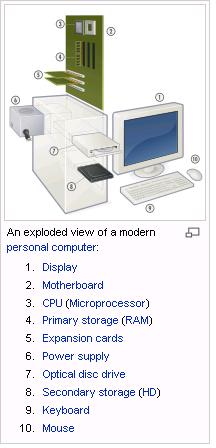
The architecture describes a computer with four main sections: the arithmetic and logic unit (ALU), the control circuitry, the memory, and the input and output devices (collectively termed I/O). These parts are interconnected by bundles of wires (called "buses" when the same bundle supports more than one data path) and are usually driven by a timer or clock (although other events could drive the control circuitry).

Conceptually, a computer's memory can be viewed as a list of cells. Each cell has a numbered "address" and can store a small, fixed amount of information. This information can either be an instruction, telling the computer what to do, or data, the information which the computer is to process using the instructions that have been placed in the memory. In principle, any cell can be used to store either instructions or data.

The ALU is in many senses the heart of the computer. It is capable of performing two classes of basic operations. The first is arithmetic operations; for instance, adding or subtracting two numbers together. The set of arithmetic operations may be very limited; indeed, some designs do not directly support multiplication and division operations (instead, users support multiplication and division through programs that perform multiple additions, subtractions, and other digit manipulations). The second class of ALU operations involves comparison operations: given two numbers, determining if they are equal, or if not equal which is larger.

The I/O systems are the means by which the computer receives information from the outside world, and reports its results back to that world. On a typical personal computer, input devices include objects like the keyboard and mouse, and output devices include computer monitors, printers and the like, but as will be discussed later a huge variety of devices can be connected to a computer and serve as I/O devices.

The control system ties this all together. Its job is to read instructions and data from memory or the I/O devices, decode the instructions, providing the ALU with the correct inputs according to the instructions, "tell" the ALU what operation to perform on those inputs, and send the results back to the memory or to the I/O devices. One key component of the control system is a counter that keeps track of what the address of the current instruction is; typically, this is incremented each time an instruction is executed, unless the instruction itself indicates that the next instruction should be at some other location (allowing the computer to repeatedly execute the same instructions).

Since the 1980s the ALU and control unit (collectively called a central processing unit or CPU) have typically been located on a single integrated circuit called a microprocessor.

The functioning of such a computer is in principle quite straightforward. Typically, on each clock cycle, the computer fetches instructions and data from its memory. The instructions are executed, the results are stored, and the next instruction is fetched. This procedure repeats until a halt instruction is encountered.

The set of instructions interpreted by the control unit, and executed by the ALU, are limited in number, precisely defined, and very simple operations. Broadly, they fit into one or more of four categories: 1) moving data from one location to another (an example might be an instruction that "tells" the CPU to "copy the contents of memory cell 5 and place the copy in cell 10"). 2) executing arithmetic and logical processes on data (for instance, "add the contents of cell 7 to the contents of cell 13 and place the result in cell 20"). 3) testing the condition of data ("if the contents of cell 999 are 0, the next instruction is at cell 30"). 4) altering the sequence of operations (the previous example alters the sequence of operations, but instructions such as "the next instruction is at cell 100" are also standard).

Instructions, like data, are represented within the computer as binary code — a base two system of counting. For example, the code for one kind of "copy" operation in the Intel x86 line of microprocessors is 10110000 [4]. The particular instruction set that a specific computer supports is known as that computer's machine language. Using an already-popular machine language makes it much easier to run existing software on a new machine; consequently, in markets where commercial software availability is important suppliers have converged on one or a very small number of distinct machine languages.

More powerful computers such as minicomputers, mainframe computers and servers may differ from the model above by dividing their work between more than one main CPU. Multiprocessor and multicore personal and laptop computers are also beginning to become available.

Supercomputers often have highly unusual architectures significantly different from the basic stored-program architecture, sometimes featuring thousands of CPUs, but such designs tend to be useful only for specialized tasks. At the other end of the size scale, some microcontrollers use the Harvard architecture that ensures that program and data memory are logically separate.

Saturday, August 26, 2006

Architecture

Architecture (from Latin, architectura and ultimately from Greek, αρχιτεκτων, "a master builder", from αρχι- "chief, leader" and τεκτων, "builder, carpenter") is the art and science of designing buildings and Structure.

wider definition would include within its scope the design of the total built environment, from the macrolevel of Structure, urban, and landscape architecture to the microlevel of creating furniture. Architectural design usually must address both feasibility and cost for the builder, as well as function and aesthetics for the user.

In modern usage, architecture is the art and discipline of creating an actual, or inferring an implied or apparent plan of any complex object or system. The term can be used to connote the implied architecture of abstract things such as music or mathematics, the apparent architecture of natural things, such as geological formations or the structure of biological cells, or explicitly planned architectures of human-made things such as software, computers, enterprises, and databases, in addition to buildings. In every usage, an architecture may be seen as a subjective mapping from a human perspective (that of the user in the case of abstract or physical artifacts) to the elements or components of some kind of structure or system, which preserves the relationships among the elements or components.

Planned architecture often manipulates space, volume, texture, light, shadow, or abstract elements in order to achieve pleasing aesthetics. This distinguishes it from applied science or engineering, which usually concentrate more on the functional and feasibility aspects of the design of constructions or structures.

In the field of building architecture, the skills demanded of an architect range from the more complex, such as for a hospital or a stadium, to the apparently simpler, such as planning residential houses. Many architectural works may be seen also as cultural and political symbols, and/or works of art. The role of the architect, though changing, has been central to the successful (and sometimes less than successful) design and implementation of pleasingly built environments in which people live.

Architectural history

Architecture first evolved out of the dynamics between needs (shelter, security, worship, etc.) and means (available building materials and attendant skills). Prehistoric and primitive architecture constitute this early stage. As humans progressed and knowledge began to be formalised through oral traditions and practices, architecture evolved into a craft. Here there is first a process of trial and error, and later improvisation or replication of a successful trial. What is termed Vernacular architecture continues to be produced in many parts of the world. Indeed, vernacular buildings make up most of the built world that people experience every day.

Early human settlements were essentially rural. As surplus of production began to occur, rural societies transformed into urban ones and cities began to evolve. In many ancient civilisations such as the Egyptians' and Mesopotamians' architecture and urbanism reflected the constant engagement with the divine and the supernatural, while in other ancient cultures such as Iran architecture and urban planning was used to exemplify the power of the state.

However, the architecture and urbanism of the Classical civilisations such as the Greek and the Roman evolved from more civic ideas and new building types emerged. Architectural styles developed and texts on architecture began to be written. These became canons to be followed in important works, especially religious architecture. Some examples of canons are the works of Vitruvius, the Kaogongji of ancient China and Vaastu Shastra in ancient India. In Europe in the Classical and Medieval periods, buildings were not attributed to specific individual architects who remained anonymous. Guilds were formed by craftsmen to organise their trade. Over time the complexity of buildings and their types increased. General civil construction such as roads and bridges began to be built. Many new building types such as schools, hospitals, and recreational facilities emerged.

Islamic architecture has a long and complex history beginning in the seventh century CE. Examples can be found throughout the countries that are, or were, Islamic - from Morocco and Spain to Turkey, Iran and Pakistan. Other examples can be found in areas where Muslims are a minority. Islamic architecture includes mosques, madrasas, caravansarais, palaces, and mausolea of this large region.

With the Renaissance and its emphasis on the individual and humanity rather than religion, and with all its attendant progress and achievements, a new chapter began. Buildings were ascribed to specific architects - Michaelangelo, Brunelleschi, Leonardo da Vinci - and the cult of the individual had begun. But there was no dividing line between artist, architect and engineer, or any of the related vocations. At this stage, it was still possible for an artist to design a bridge as the level of structural calculations involved was within the scope of the generalist.

With the consolidation of knowledge in scientific fields such as engineering and the rise of new materials and technology, the architect began to lose ground on the technical aspects of building. He therefore cornered for himself another playing field - that of aesthetics. There was the rise of the "gentleman architect" who usually dealt with wealthy clients and concentrated predominantly on visual qualities derived usually from historical prototypes. In the 19th century Ecole des Beaux Arts in France, the training was toward producing quick sketch schemes involving beautiful drawings without much emphasis on context.

Meanwhile, the Industrial Revolution laid open the door for mass consumption and aesthetics started becoming a criterion even for the middle class as ornamented products, once within the province of expensive craftsmanship, became cheaper under machine production.

The dissatisfaction with such a general situation at the turn of the twentieth century gave rise to many new lines of thought that in architecture served as precursors to Modern Architecture. Notable among these is the Deutscher Werkbund, formed in 1907 to produce better quality machine made objects. The rise of the profession of industrial design is usually placed here. Following this lead, the Bauhaus school, founded in Germany in 1919, consciously rejected history and looked at architecture as a synthesis of art, craft, and technology.

When Modern architecture was first practiced, it was an avant-garde movement with moral, philosophical, and aesthetic underpinnings. Modernist architects sought to reduce buildings to a pure form, removing historical references in favor of purely functional structures. The columns, arches, and gargoyles of Classical architecture were dubbed unnecessary. Buildings that flaunted their construction, exposing steel beams and concrete surfaces instead of hiding them behind traditional forms, were seen as beautiful in their own right. Architects such as Mies van der Rohe worked to reject virtually all that had come before, trading handcrafted details and sentimental historic forms for a machine-driven architectural geometry made possible by the Industrial Revolution.

Many people saw Modernism as dull or even ugly. As the founders of the International Style lost influence, Postmodernism developed as a reaction against the purity of Modernism. Robert Venturi's contention that a "decorated shed" (an ordinary building which is functionally designed inside and embellished on the outside) was better than a "duck" (a building in which the whole form and its function are tied together) gives an idea of this approach.

Another part of the profession, and also some non-architects, responded by going to what they considered the root of the problem. They felt that architecture was not a personal philosophical or aesthetic pursuit by individualists; rather it had to consider everyday needs of people and use technology to give a livable environment. The Design Methodology Movement involving people such as Chris Jones, Christopher Alexander started searching for more people-orientated designs. Extensive studies on areas such as behavioural, environmental, and social sciences were done and started informing the design process.

As many other concerns began to be recognised and complexity of buildings began to increase in terms of aspects such as services, architecture started becoming more multi-disciplinary than ever. Architecture now required a team of professionals in its making, an architect being one among the many, sometimes the leader, sometimes not. This is the state of the profession today. However, individuality is still cherished and sought for in the design of buildings seen as cultural symbols - the museum or fine arts centre has become a showcase for new experiments in style: today one style, tomorrow maybe something else.


Thursday, August 24, 2006

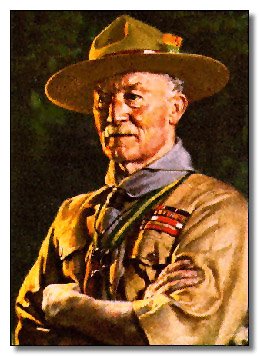
Robert Baden-Powell


AKA Robert Stephenson Smyth Baden-Powell


Born:22-Feb-1857
Birthplace:London, England
Died: 8-Jan
Location of death: Nyeri, Kenya
Cause of death: unspecified

Gender: Male
Religion: Anglican/Episcopalian
Ethnicity: White
Sexual orientation: Bisexual
Occupation: Military
Nationality: England
Executive summary: Founder of the Boy Scout movement

Military service: British Army (13th Hussars, India; Boer War; 5th Dragoon Guards India)

Father: Baden Powell (professor of geometry Oxford, reverend, d. 1860)
Mother: Henrietta Grace Smyth
Sister: Agnes Baden-Powell (helped to found Girl Guides movement)
Wife: Olave Soames (m. 30-Oct-1912, one son, two daughters)
Son: Peter
Daughter: Heather
Daughter: Betty Clay (VP Scouting movement, awarded CBE in 1997, d. 24-Apr-2004)
Boyfriend: Kenneth McClaren (there is circumstancial evidence to support this)

High School: Charterhouse School, Godalming, Surrey, England

Knight of the British Empire 1909
Silver Buffalo

Author of books:
Pig-Sticking Or Hog-Hunting: A Complete Account For Sportsmen - And Others (1889, nonfiction)
The downfall of Prempeh: A diary of life with the native levy in Ashanti 1895-96 (1896, memoir)
My Adventures as a Spy (1915, memoir)
Memories of India: Recollections of Soldiering and Sport (1915, memoir)
The Piper of Pax: The Life-Story of Sir Robert Baden-Powell (1925, memoir)
Life's Snags and How to Meet Them (1927, self help)

Tuesday, August 08, 2006

Shojin Ryori


In the 13th century, Zen monks from China popularized a form of vegetarian cuisine in Japan known as shojin ryori. The practice of preparing delicious meals with seasonable vegetables and wild plants from the mountains, served with seaweed, fresh soybean curd (or dehydrated forms), and seeds (such as walnuts, pine nuts and peanuts) is a tradition that is still alive at Zen temples today. Stemming from the Buddhist precept that it is wrong to kill animals, including fish, shojin ryori is completely vegetarian. Buddhism prescribes partaking of a simple diet every day and abstaining from drinking alcohol or eating meat. Such a lifestyle, together with physical training, clears the mind of confusion and leads to understanding.
Even in preparing shojin ryori batter, we do not use unfertilized eggs as a binder; we use yam instead, which works quite well. Shojin ryori cooks also make sure not to waste any of the ingredients. We even sauté the greens and peelings of carrots and daikon radish, then simmer them in a little water, or we add them to soup. If there are any byproducts remaining after this, we mix them with leftover rice to make porridge for the evening. Followers of Zen try to eat all of the food prepared during the day, and throw nothing edible away. This "recycling" is easy if one minimizes seasoning, letting the natural flavor of the ingredients define the taste.
The Zen aversion to waste extends to dishware, too. When Japanese people eat deep-fried tempura, they use extra dishes for the dipping sauce. Followers of Zen, on the other hand, feel that sauces are extravagant to prepare and tend to drip and make a mess anyway, so we forgo using dipping sauces altogether. In fact, sauces are unnecessary with a little salt in the batter, or if one simmers vegetables in miso-flavored water before deep-frying them.
People ask me if I can maintain a balanced diet while eating only vegetables; the answer, of course, is yes. I have been following Buddhist training and eating only vegetarian meals for more than 50 years, yet have never even caught a cold in all that time. Life at a Zen temple is strict and demands much physical labor, but I can take it in stride because I have the power of seasonal vegetables on my side. Of course, shojin ryori is part of the Buddhist temple regimen, yet it is also my way of maintaining a sound mind and body.

Tuesday, August 01, 2006

Beauty Tips

For attractive lips,
Speak words of kindness.
For lovely eyes,
Seek out the good in people.

For a slim figure,
Share your food with the hungry.
For beautiful hair,
Let a child run his or her fingers through it once a day.

For poise,
Walk with the knowledge that you will never walk alone.
People, even more than things, have to be restored, renewed, revived, reclaimed, and redeemed; Never throw out anybody.

Remember, If you ever need a helping hand, you'll find one at the end of your arm.
As you grow older, you will discover that you have two hands, one for helping yourself, the other for helping others.

The beauty of a woman is not in the clothes she wears, The figure that she carries, or the way she combs her hair. The beauty of a woman must be seen from in her eyes, Because that is the doorway to her heart, the place where love resides.

The beauty of a woman is not in a facial mole, But true beauty in a woman is reflected in her soul. It is the caring that she lovingly gives, the passion that she shows. And the beauty of a woman, with passing years, only grows.